
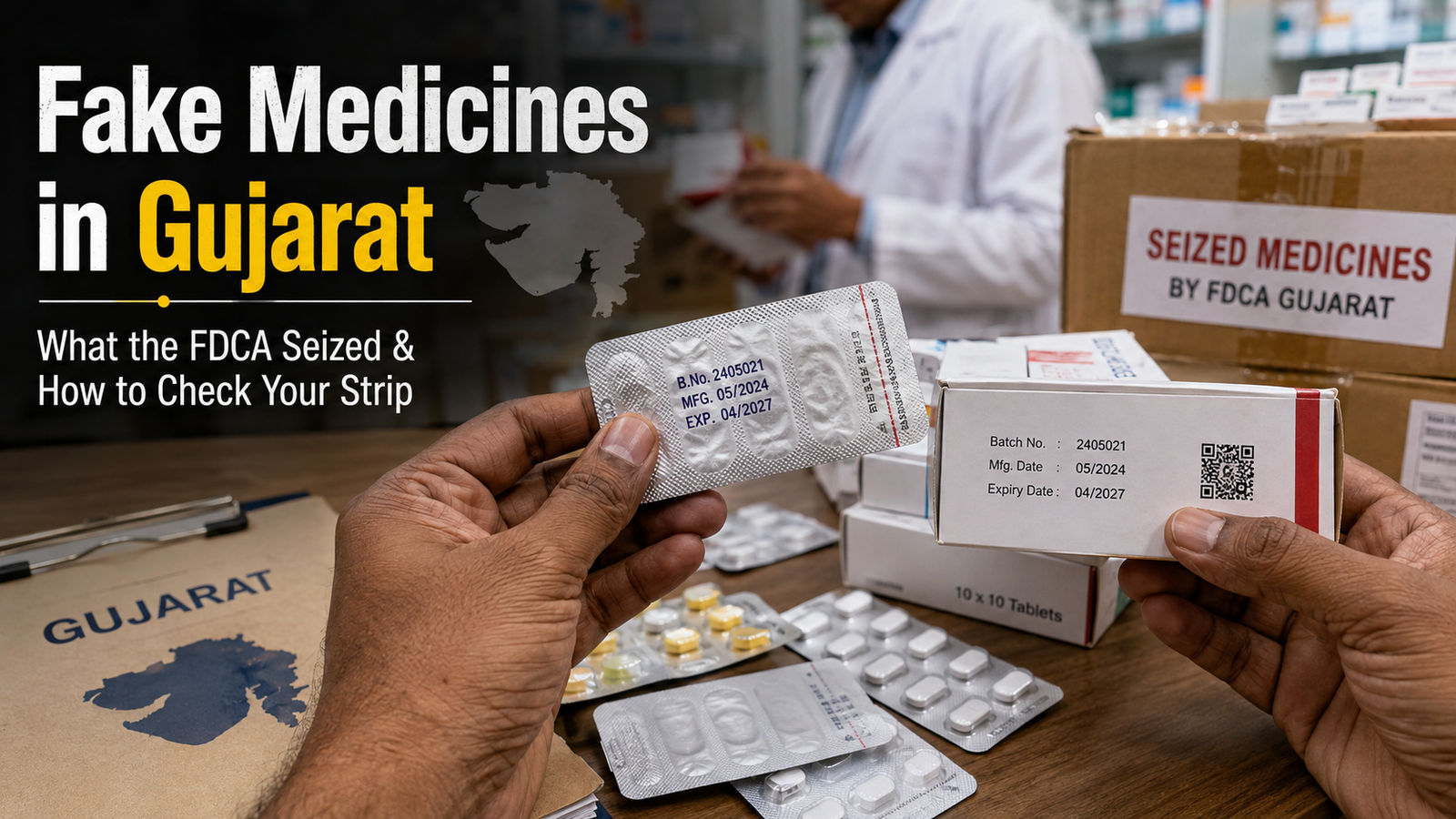
A strip of blood pressure tablets does not look like a crime scene. It looks like the thing on the shelf next to the sugar jar, the one an older relative takes every morning without thinking about it. That is exactly why the three days of inspections the Gujarat Food and Drug Control Administration ran between 19 and 22 August landed the way they did. The fake medicines in Gujarat that turned up in that sweep were not party drugs or exotic imports. They were ordinary heart and blood pressure tablets, sold over an ordinary counter.
Inspectors checked more than 30 firms, medical stores and distribution agencies across the state in those three days. Health Minister Praful Pansheriya directed the operation. We first reported fake medicine surfacing in Gujarat as the news broke. What they took away is worth understanding in detail, because the specifics tell you more about your own medicine cabinet than the headline does.
What the inspectors actually found
The products flagged as counterfeit or duplicate included NICARDIA RETARD 10 and NICARDIA RETARD 20 tablets, along with CILACAR 5, CILACAR 10 and CILAKAR TM 50. One batch number in particular, ACG25007 of NICARDIA RETARD 10, was singled out. At Nakshn Medical Store in Nadiad, 660 tablets of that product were seized.
Across the sweep, suspicious stock valued at roughly 1.70 lakh rupees was prohibited from sale pending investigation. Samples have gone for laboratory testing, and the FDCA has said the inquiry will follow the chain back to the manufacturing level, with police action possible depending on what the testing shows.
In rupee terms 1.70 lakh is a small number. In tablet terms it is not, and in patient terms it is not remotely small.
Why these particular medicines matter
NICARDIA and CILACAR are not painkillers or vitamins. They are calcium channel blockers, the kind of drug prescribed for high blood pressure and certain heart conditions, and they are taken every single day, usually for years, usually by people over 50.
That changes the nature of the risk. If a counterfeit paracetamol contains nothing, a person has a headache for an afternoon. If a counterfeit blood pressure tablet contains nothing, the patient believes their pressure is being controlled while it is not, and nothing about how they feel will necessarily tell them otherwise. High blood pressure is called a silent condition for a reason. A fake strip does not announce itself. It simply removes the protection quietly, week after week, until something happens that does announce itself.
That is the practical case for taking a counterfeit cardiac drug more seriously than the seizure value suggests.
The trail from Lucknow to a Satellite pharmacy
What makes this particular case instructive is that investigators mapped the route rather than just the endpoint. The chain identified so far runs from Sena Pharmas in Lucknow to Parsh Medical Agency in Paldi, Ahmedabad, on to Paras Ecomad in Satellite, then through Sanand Medical Stores, and finally to Lilavati Pharmacy and Wellness Pvt. Ltd. in Satellite, Ahmedabad.
Read that list again and notice what it does not contain. There is no back-alley operation in it. Every link is a registered-looking business with an address and an invoice book. Counterfeit medicine in India rarely enters through a hole in the wall. It enters through paperwork, at a point in a legitimate supply chain where nobody is checking hard enough, and then it moves the rest of the way as normal stock.
Purchase and sale records at each of those points are now being examined.
Fake medicines in Gujarat: this is not the first crackdown this year
The August sweep followed a much larger action earlier in the year. On 3 May, the FDCA seized or prohibited drugs worth about 1.21 crore rupees across Ahmedabad, Vadodara, Savli and Bharuch.
That operation covered different ground. At Pavan Formulation in Ahmedabad, codeine-based syrup with narcotic content worth 76.51 lakh rupees was prohibited. A product sold by Yusuf Medicines in Gomtipur was declared spurious after an ayurvedic preparation was found to contain the allopathic painkiller diclofenac, which no label had disclosed. Times Medicament Private Limited had stock worth 4.60 lakh rupees seized over unauthorised relocation and billing irregularities involving Mounjaro injections. A Vadodara firm had its licence permanently cancelled for selling those injections without prescriptions. Two more units lost licences or export permits over high-dose Tapentadol. Around 40 lakh rupees of stock was seized from an unlicensed storage point in a shopping centre.
The minister described the state position at the time as zero tolerance. More public safety alerts from across Gujarat are collected here. Four months later the inspectors were back out, which is either evidence that enforcement is working or evidence of how much there is to find. Realistically it is both.
How to check a strip before you take it
None of this is a reason to panic about every tablet in the house. It is a reason to spend twenty seconds looking at the ones you take daily.
- Scan the QR code. Since 1 August 2023, India has required a barcode or QR code on the packaging of the top 300 drug brands. Most commonly prescribed cardiac and blood pressure medicines fall in that list. A missing code on a brand that should carry one, or a code that scans to nothing, is worth questioning.
- Compare with your last strip. You have been buying the same medicine for years. Hold the new strip next to the old one and look at the font weight, the colour, the alignment of the printing and the finish of the foil. Counterfeits usually get one of those slightly wrong.
- Read the batch number and dates. Batch number, manufacturing date and expiry should be printed cleanly, not smudged, not stamped over, not oddly spaced. Check the batch against any recall notice your chemist has been given.
- Look for the manufacturer details. A genuine pack carries the manufacturer name, address and licence number. Vagueness there is a warning sign.
- Keep the bill. A proper GST bill from a licensed chemist is what lets an investigation trace anything at all. It is also what protects you.
- Notice the tablet itself. Unusual smell, crumbling edges, a colour that has changed from the strip you finished last month, or a break line that sits differently, are all worth a second look.
What to do if you think you have a fake
Do not simply stop taking a prescribed medicine because you are worried about the strip. For blood pressure and cardiac drugs in particular, stopping abruptly carries its own risk. Speak to your doctor first and get a replacement from a different licensed chemist.
Keep the suspect strip, the outer carton and the bill rather than throwing them away, since without those there is nothing to test. Report it to the Gujarat FDCA, which handles drug quality complaints in the state, and tell the chemist who sold it, because a genuine retailer will want to pull the rest of that batch off the shelf.
This article is general information and not medical advice. Any decision about your own medication belongs with your doctor or pharmacist.
What the system still has to fix
Seizures make good headlines and they do remove bad stock from circulation. What they do not do is answer the question underneath: how did counterfeit cardiac tablets travel through four registered businesses across two states without anyone stopping them?
Until verification at each handover point becomes routine rather than occasional, the pattern will hold. Fake medicines in Gujarat will keep surfacing in three-day sweeps, the value seized will keep being reported in lakhs, and the actual exposure will keep being measured in something harder to count, which is the number of people who took the tablet and assumed it worked.
Also read: NEET UG 2026 paper leak: what happened and where counselling stands now.

One thought on “Fake Medicines in Gujarat: What the FDCA Seized and How to Check Your Own Strip”